Part 1 of taking a design org AI-first
My team got smaller. The roadmap didn’t.
That left three options. Cut scope. Push people harder. Or change how the work gets done.
Cutting scope is a slow way of telling the business that design matters less. Pushing harder works for a quarter, then good people leave. So I took the third. Not because it was bold. Because it’s the only one that holds.
The trap
Most design teams using AI think they’ve transformed. They haven’t. Everyone has a chatbot. Copy gets drafted faster, research gets summarised, someone generates a few icons. Each person saves a few hours a week.
That’s real. It’s also not enough. Hours saved per person don’t add up to the people you no longer have.
Notion’s AI Transformation Model, built with Ben Levick at Ramp and Geoffrey Litt, names this well. It has four levels: AI as a thought partner, as an assistant, as a teammate, and finally as the system. Level 2 is measured in hours saved per employee. Level 3 is measured in team capacity: agents take over recurring work, and operations scale “without proportional headcount”.
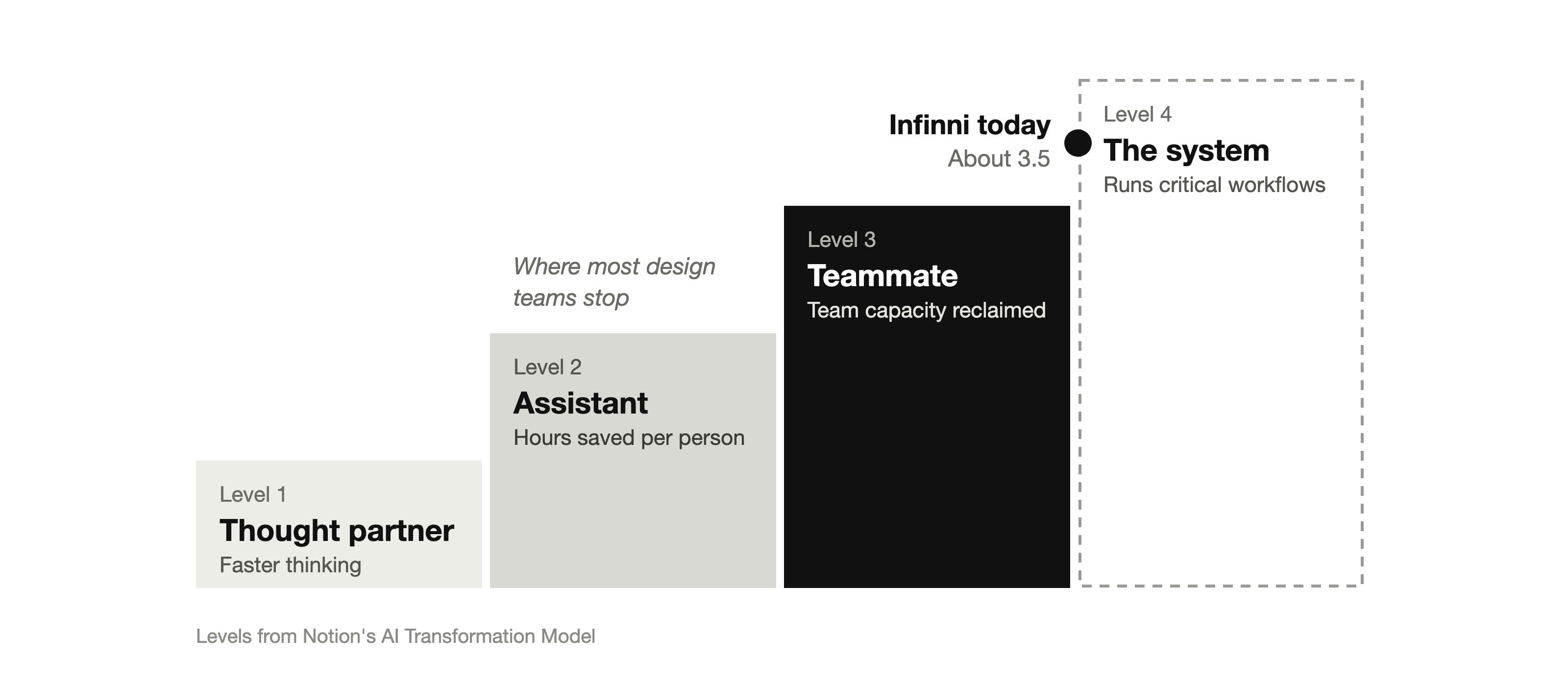
That line was my brief. A smaller team doesn’t need faster designers. It needs work done that nobody on the team has to do.
We went in to survive. What we found was a better way to design.
Design tools were always proxies
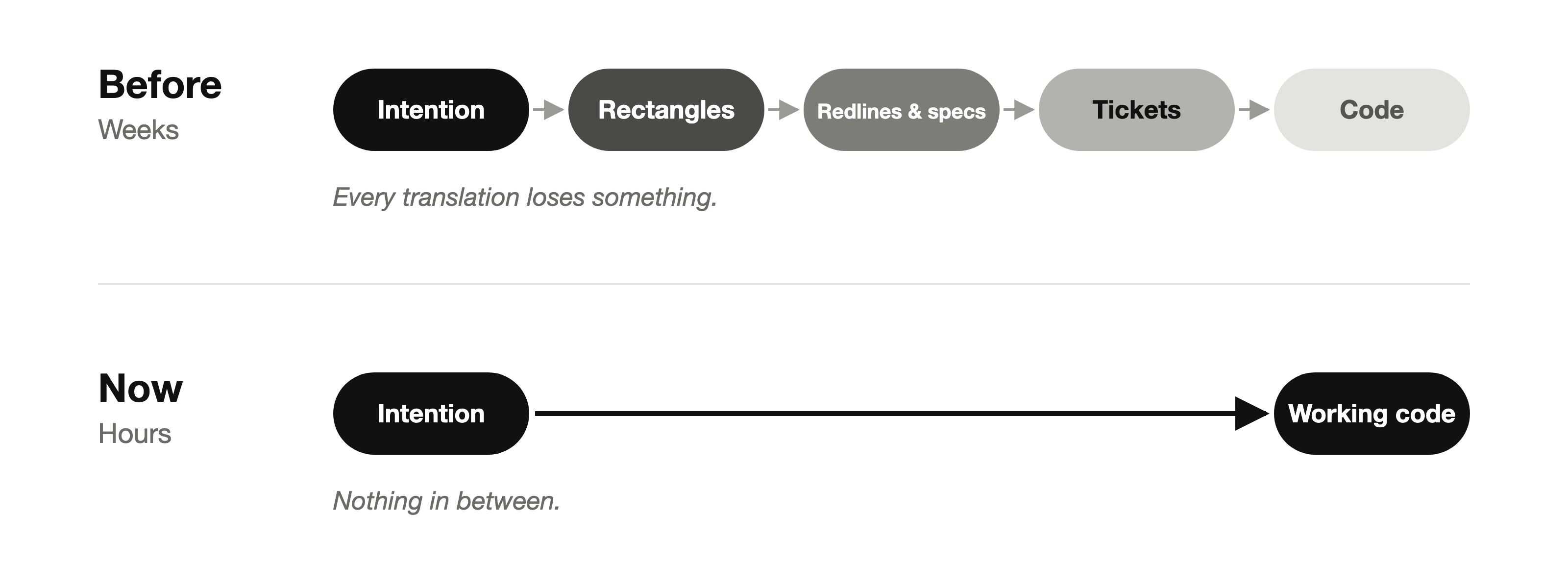
A designer has an intention. Before it reaches a user, it gets translated. Into rectangles. Into redlines and specs. Into tickets. Into code, by someone who wasn’t in the room. Every translation loses something.
Our industry spent decades building bridges across that gap. Design tokens. Component libraries. Figma libraries. Design systems. Handoff tools. Each one shortened the chain. None removed it. And each one added something new to maintain.
Design tools were never the work. They were the best proxy we had for what designers meant.
Purity
AI has closed the gap.
At Infinni, a designer states what they want: in words, a sketch, a screenshot, a reference from another app. Claude builds it as working code from our real design system. No file in between. No spec. No ticket. One step where there used to be five.
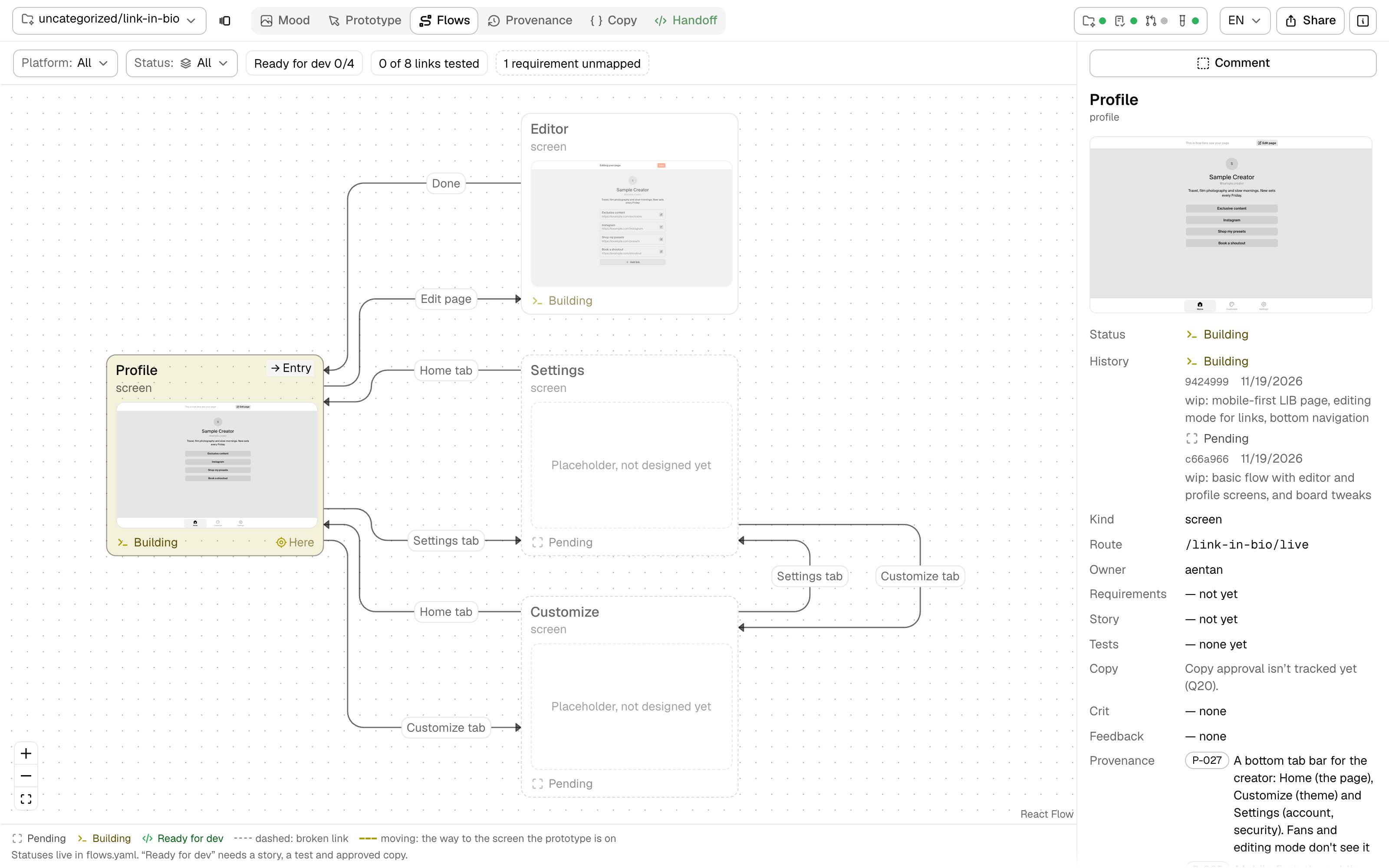
Never before have a designer’s intentions been captured with this much purity.
The proof is time. Design intention to testable code used to take weeks. Now it takes hours. Not a mockup that looks right. Code you can click through, test with users and hand to engineering.
And purity scales with the model. The bridges we built ourselves improved one tool release at a time. This one improves every time the models do, without us rebuilding anything. What we have today is the floor.
“Designers will generate bad code”
It’s the first objection, every time. It’s the wrong frame.
Designers don’t write the code. And bad code doesn’t get through.
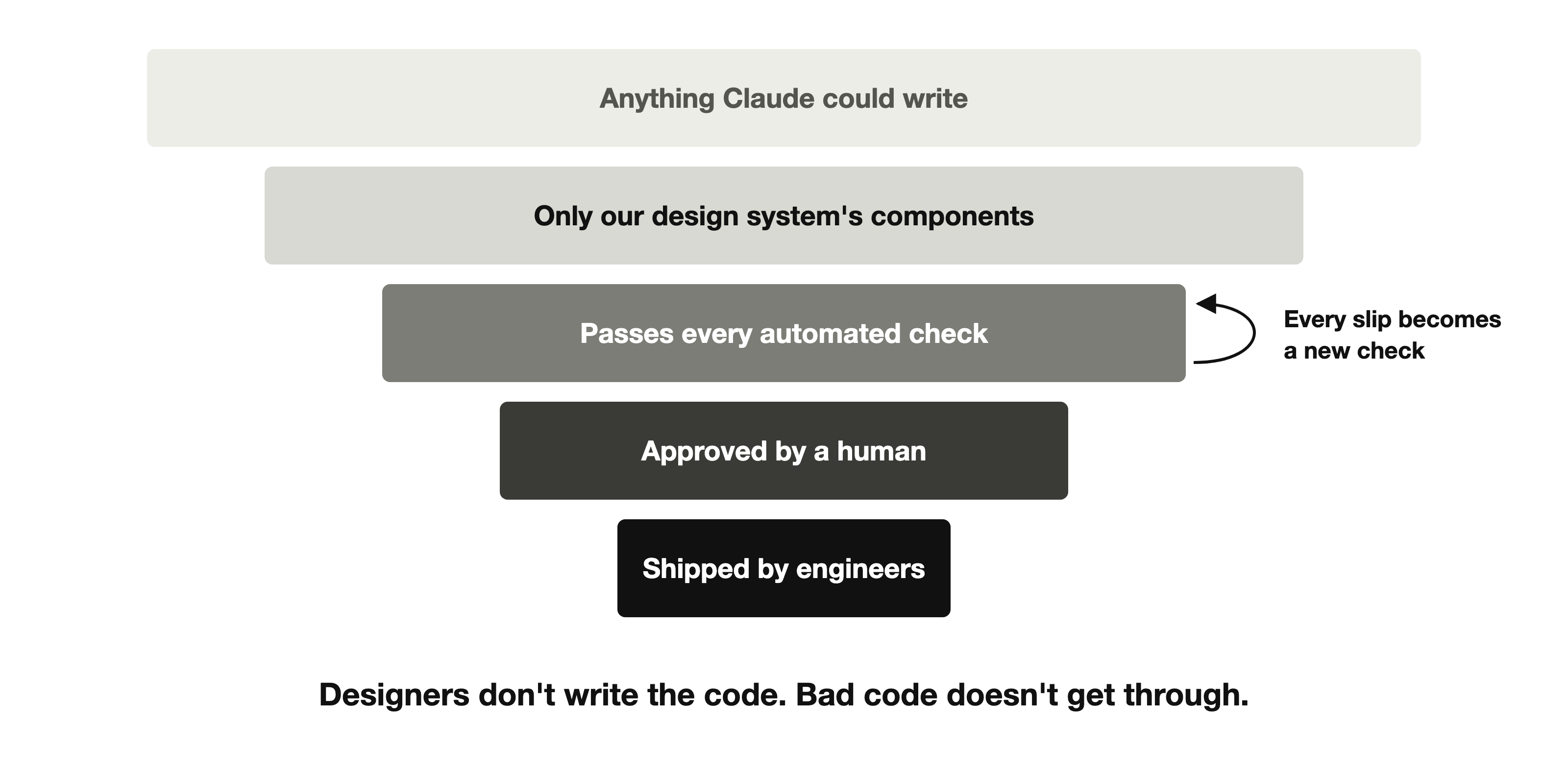
- Limit what can be written. Claude builds only from the design system’s components and tokens, the standard way. No forked components, no workarounds. Most bad code never gets the chance to exist.
- Block what’s wrong, without opinions. Deterministic checks run on every change, on the designer’s laptop and again in CI. They pass or they fail. AI review comments; it never decides. We test the checks too: each one is broken on purpose to prove it fails.
- Turn every slip into a rule. When AI-written code sneaks something past us, we don’t just fix it. We add the lint rule or test that catches it next time. The system gets stricter with every mistake.
- Engineers own production. The workspace isn’t the product. A human approves every change. Nothing ships because a model said so.
Engineers write bad code too. Now everyone answers to the same checks.
What’s left for designers
When execution stops being the bottleneck, the bottleneck is knowing what you want.
That’s not a smaller job. It’s the job: taste, judgment, clarity of intent. Designers who leaned on tool mastery will feel the ground move. The ones who always knew what they wanted just got faster than they’ve ever been.
The work nobody does any more
Level 3 isn’t a slide. It’s a list of jobs that used to eat someone’s week:
- Feedback on the design board is triaged every weekday morning, before anyone opens it.
- A Slack discussion becomes a written decision with one command.
- Precedent from real apps lands on a moodboard when you ask.
- A first-pass design crit runs on any screen, from any input. No citation, no finding.
- Every change gets a review that tells the human approver what to read and what to skip.
- Releases announce themselves.
Each one gave capacity back the week it shipped. You don’t have to reach the top of the scale to feel it. That’s why getting there matters, even before you arrive.
Where we are
About 3.5.
Notion’s model has no half-steps. It does say teams and workflows mature at their own pace. That’s us. Recurring work runs on agents, with people at the checkpoints: solid Level 3. The system that checks our work gets stricter on its own: a Level 4 trait.
What keeps us from a 4 is simple. The core workflow, brief to handoff, isn’t run end to end by the system yet. And Notion expects 10–20% of a company to build agents. We have one builder.
For other design leaders
If AI only makes your design files faster, you’ve automated the proxy. Go after the gap.
Part 2: inside the workspace.