Part 3 of taking a design org AI-first
Part 2 was about the engine every workspace runs on. This part is about what every Claude working on it knows, which turned out to matter just as much.
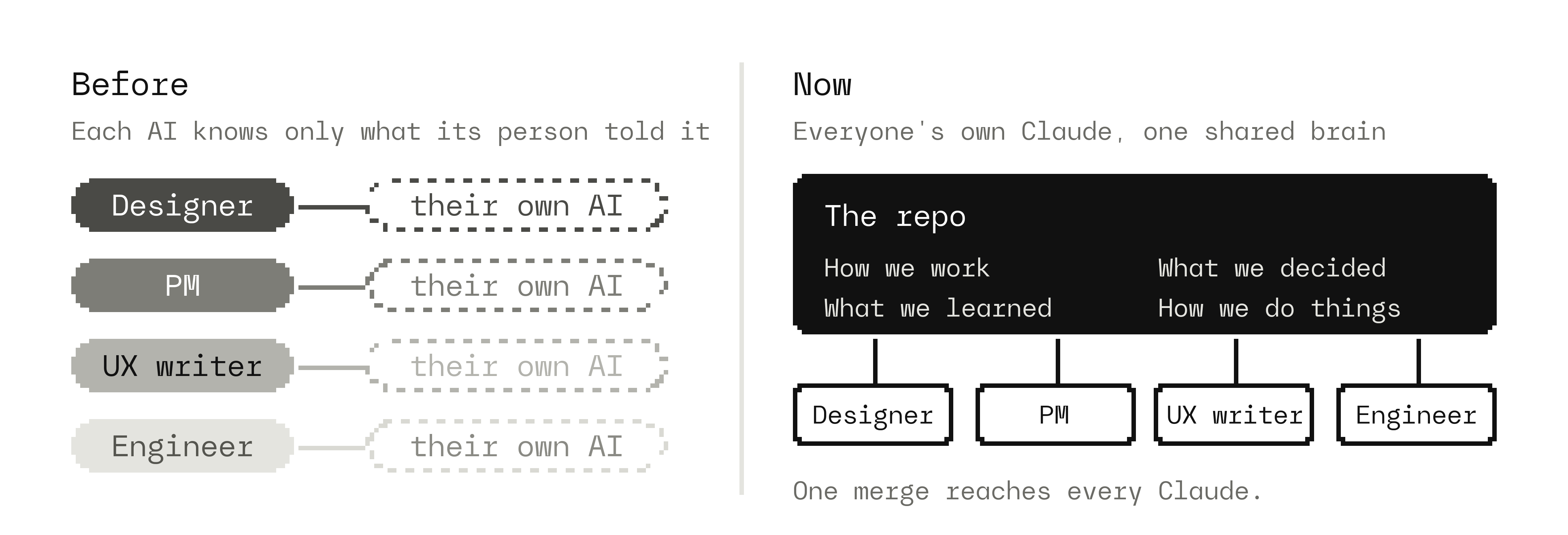
Give a team AI and you get one private assistant per person. Each knows only what its person has told it, and most of that is gone by the next session. Everyone gets faster on their own, but nothing one person teaches their AI ever reaches anyone else’s. That’s the quiet ceiling of Level 2 in Notion’s model: hours saved per person, and a team that never gets smarter as a whole. A smaller team can’t afford to learn the same lesson five times.
Not one AI, one brain
The obvious fix is a single shared AI: a team account, a shared project, a long prompt everyone pastes in. We decided against it early. A shared project holds knowledge that slowly drifts away from the work, and the conversations inside it aren’t shared anyway. People also already have their own AI, with their own connectors and habits, and taking that away to buy alignment is a bad trade. So everyone brings their own Claude, and what they share is the brain.
The brain is a handful of files in Git. Part 2 showed the folder every workspace starts with, and two lines in it are easy to skip: .claude/ and CONTEXT.md. They’re that workspace’s brain, and the engine ships them to every workspace. The team has one too, in the repo where we plan and decide:
design-next-planning/
├─ .claude/           the team's Claude kit
│  ├─ agents/         the agents' prompts
│  ├─ hooks/          what can never happen
│  ├─ rules/          how we write
│  └─ skills/         how we do recurring jobs
├─ decisions/         what we decided, one file each
├─ docs/              how it all works
├─ memory/            the team's memory
│  └─ learnings.md    what we learned, one line each
├─ CLAUDE.md          how we work
├─ CONTEXT.md         where Claude starts reading
└─ open-questions.md  what's still open
Whoever’s Claude opens it reads the same files first. It learns how we work, what we’ve decided and what we’ve learned, and it picks up skills for the recurring jobs: proposing a change, recording a decision, triaging feedback from the design board. It won’t reopen a settled decision; it proposes a replacement instead. Because these files live in Git next to the work, they change the way everything else does, by pull request, and once a change merges, every teammate’s Claude picks it up at their next sync. We don’t train people on a convention any more. We merge it.
A lesson, learned once
A small example shows how this plays out. Our Slack bots have short, friendly names, and it turns out strangers own those same names on GitHub. Write one as a handle in a pull request and GitHub notifies someone outside the company. In most teams the fix would be a Slack message saying “heads up, don’t do this”, which half the team reads and nobody’s AI ever sees. Here it became one line in the lessons file, and every Claude on the team knew it by its next session. Then we made the mistake impossible. A hook now blocks any GitHub write that mentions someone outside the org, so nobody has to remember it at all.
More than forty lessons went into that file in our first month, each a single dated line saying who learned it. Every new teammate’s Claude starts with all of them on day one. It’s onboarding that nobody had to sit down and write, because the team writes it as a by-product of doing the work.
Memory, habit, reflex
That story has a shape worth naming. In Part 1 I said every slip becomes a rule. This is the machinery behind it, and it starts from the observation that team knowledge comes in three strengths.
The weakest is memory: a line in a file. Claude reads it and usually follows it, which makes it cheap to add and easy to drift from. Stronger is habit, which is a skill, a step-by-step account of how to do a job the right way. We wrote skills for using our component libraries the standard way and tested them on five real bugs. With the skills, Claude passed 19 of 19 checks; without them, 73%. They ship with the engine, so every workspace has them, and a fix reaches every designer’s Claude with the next engine update. Strongest is reflex: a rule a machine enforces, such as a lint rule, a test or a hook. A reflex can’t be forgotten, and it can’t be argued with.
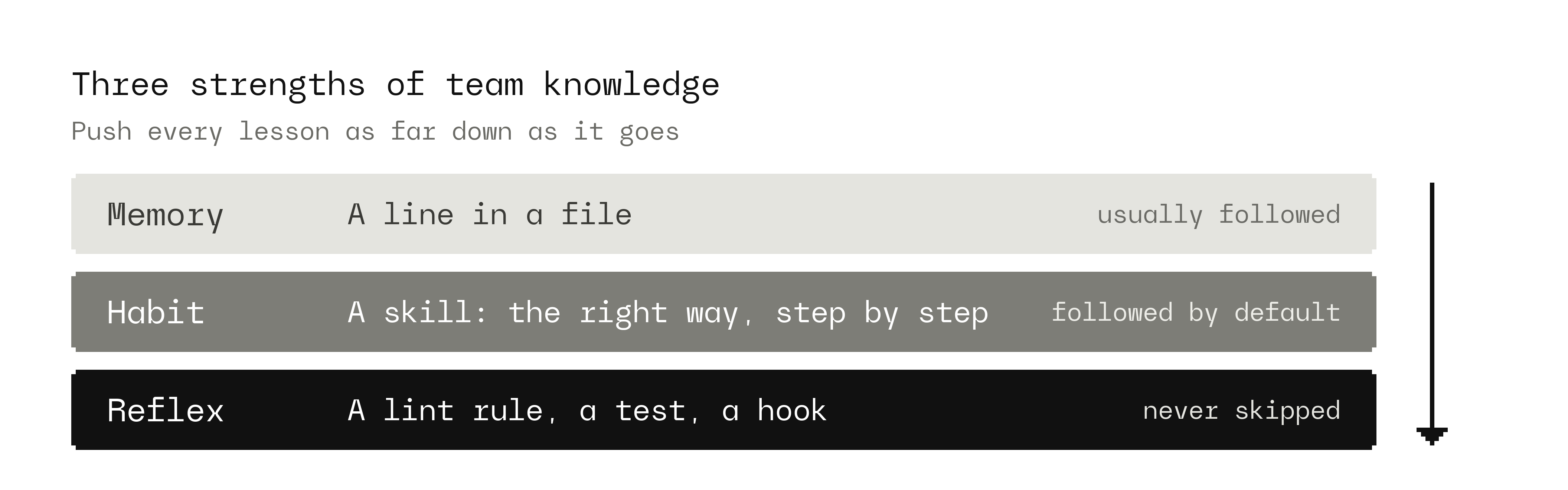
The difference matters because advice leaves room for judgement, and judgement is where slop gets in. We once audited the side effects in our own app and found that about a quarter were AI slop: code that worked around the framework instead of using it. All of it had passed review. More advice wouldn’t have caught it, and rules did. So the principle is to push every lesson as far down as it will go. A memory should become a habit when it can, and a habit should become a reflex.
Taste, written down
Rules only cover what’s right and wrong, and most of design isn’t that. It’s judgement, which is much harder to hand to a machine. Game studios have dealt with a version of this for a long time: an art bible is how hundreds of artists paint one world that looks as if one hand made it. We wrote ours for an agent to read, in three layers. The first is our own patterns, meaning the design system’s rules and our UI patterns, owned by the designers who own the system. The second is our voice: how we write, and what we call things. The third is universal heuristics, about a hundred of the field’s best-known principles, in our own words and each linked to its source. The order matters. Our pattern beats a general heuristic, so if a screen follows our pattern and breaks a heuristic, the designer isn’t flagged. The pattern gets questioned instead.
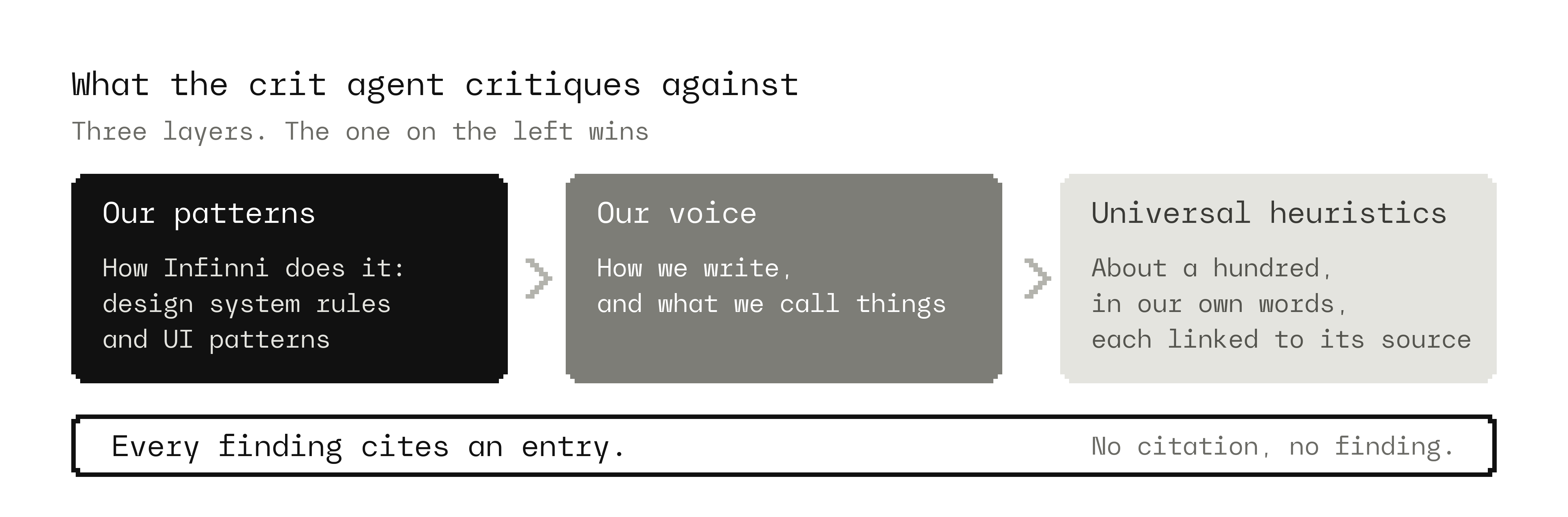
Our design crit agent critiques against these layers and nothing else, and every finding has to cite an entry. No citation, no finding. That single rule is the difference between a crit people act on and a chatbot people learn to ignore. We also curate rather than crawl. Nothing is bulk-imported, every entry is written or approved by the person who owns it, and it stays only while it keeps earning its place in real crits. A corpus nobody owns is just a longer prompt.
What it costs
Not everything belongs in the shared brain. My shortcuts, my tone and my half-formed opinions stay in my own Claude. Team knowledge is promoted by pull request, on purpose, with a person’s greenlight, and that friction is a feature. It keeps the brain from filling up with one person’s habits.
The real cost is writing things down. Designers are used to knowledge travelling by conversation, and here, if it isn’t in a file, it didn’t happen. That takes a discipline nobody needed before. The other cost is pruning. A lessons file only grows, old lessons go stale, and a stale lesson misleads every Claude at once rather than one person at a time. Today a person prunes it, and we’re building an agent to take that over.
For other design leaders
The tools your team uses will keep changing, and so will the models. What compounds is what they all know. Don’t give everyone the same AI. Give every AI the same brain, and change it by pull request.
Part 4: the crew.