Part 4 of taking a design org AI-first
At nine on a weekday morning in Singapore, three things happen at once, and nobody on the team does any of them. Yesterday’s comments on our design board are read, sorted and turned into a branch for someone to review. The team channel hears what changed in the engine and how to update. And our ops channel gets a standup nobody had to attend: who is working on what, what’s waiting for review, what’s failing and what merged. In Part 1 I called this the work nobody does any more. This part is about who does it.
Level 3 in Notion’s model is AI as a teammate. It’s an easy phrase to put on a slide and a hard one to mean. A teammate has a name, a job and someone they answer to, and most “AI teammates” have none of the three. They’re a chat window that does whatever the last person asked. So we gave ours all three, and the team started calling them the crew.
Meet the crew
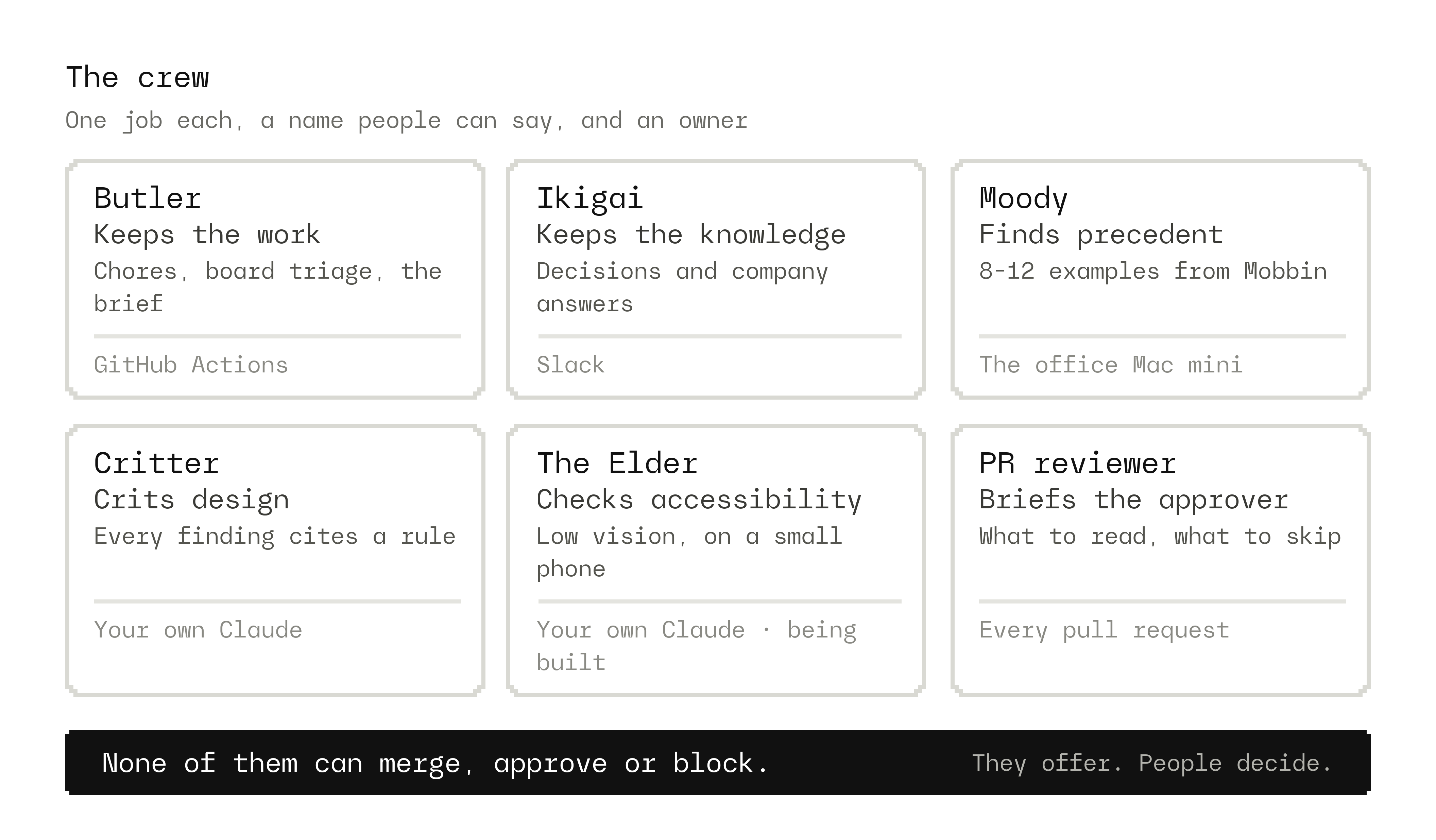
The Butler keeps the work. It tracks the repo’s chores and nudges their owners, triages the design board every weekday, announces each new engine version, and posts the morning brief and a live thread for every pull request across our five repos. Ikigai keeps the knowledge. A Slack discussion that settles something becomes a draft decision, by pull request, and a question about the company, its products or the industry gets answered in the thread from a repo of cited facts, with the source attached. Moody finds precedent. A designer says ask Moody for inspiration
, and Moody searches the team’s Mobbin account for the brief and comes back with eight to twelve examples, grouped by idea, each with a line on what it does well. The first time we asked it from a laptop, it returned eleven in under a minute. Critter is the design crit: it judges a screen against our patterns and heuristics and cites a rule for every finding. The Elder, still being built, does the same for accessibility, starting with contrast. Its persona is an older user with low vision, on a small phone. And on every pull request, the PR reviewer reads the change first and tells the human approver what to read and what to skip.
The names sound like a gimmick, and they aren’t. A name is a job description people actually remember. Ask Moody
is something a designer can say without knowing what an MCP server is, and “is that a Butler thing or an Ikigai thing?” is a question anyone on the team can answer. A name is also a boundary. When we wanted the company’s questions answered in Slack, we didn’t build a new bot: Ikigai already keeps the knowledge, so the job went to Ikigai, and the Butler, which keeps the work, stayed out of it. An agent without a name slowly turns into a junk drawer.
Offer, don’t act
The rule from Part 1 holds for every member of the crew: judgement only advises. Spotting a decision in a thread, sorting a comment and critiquing a screen are all judgement, so all of it ends in an offer, and a person makes the call. The Butler triages the design board, but it pushes its work to a branch and links it, and the owner opens the pull request. We decided early that Ikigai’s button would say Send for review, not Approve, because approval only happens on GitHub, by a person who owns the code. Nobody on the crew can merge, approve or block anything.
That doesn’t mean their advice can be ignored. When Critter or The Elder comments on a design pull request, it can’t merge until every one of those comments is answered, either fixed or dismissed with a short reason. Nobody has to agree with a finding, only answer it. Whether every thread is closed is a yes-or-no question with the same answer every time, so that check is allowed to block. Advice can’t stop a merge. Ignoring it can.
The model writes, a script decides
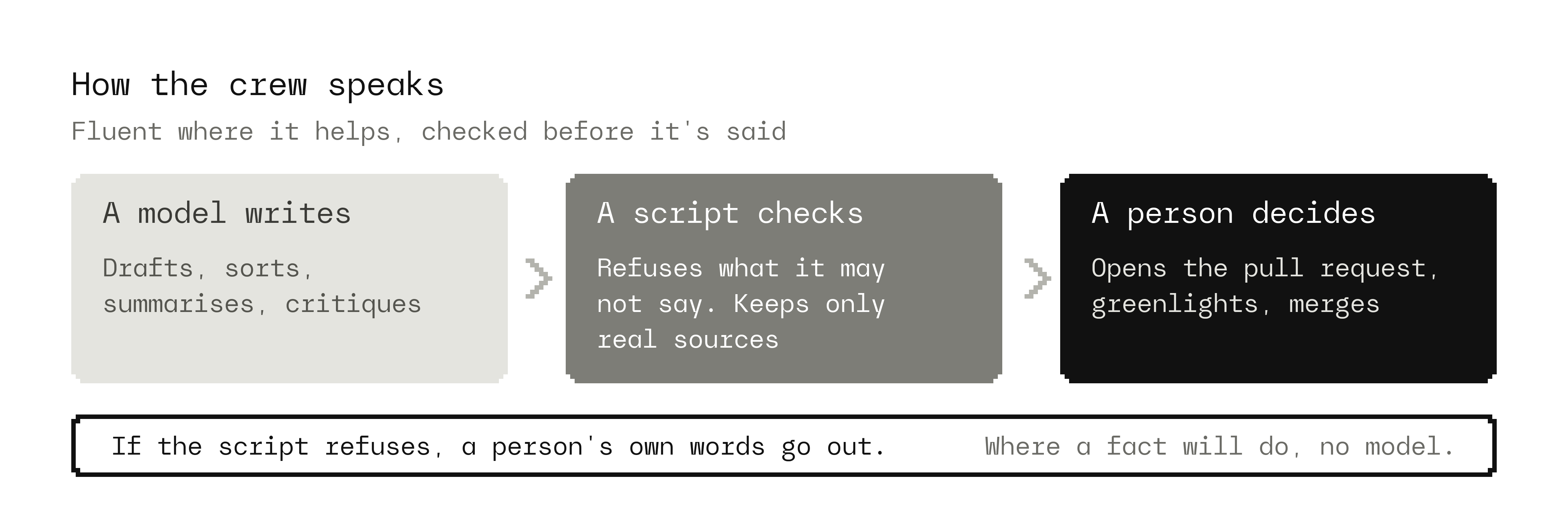
The more interesting rule came later, once the crew started talking to the whole company. A model is fluent, and fluency is exactly what makes it risky in a channel everyone reads. So whenever an agent speaks, a model writes and a script decides whether it may be said.
The engine shipped eighteen versions in two weeks, far too many for anyone to follow, so the Butler announces them. A model reads the changelog and writes two to five short lines for designers. Before anything is posted, a script refuses anything that isn’t a few short bullets, or that holds a mention, a link or a version that isn’t being announced. If the summary is refused, the post falls back to the lines the engineers wrote in the changelog themselves. Ikigai’s answers work the same way. Claude reads the company repo and drafts an answer, and code keeps only the sources that exist and the links that are really in them. If no citation survives, Ikigai quotes the repo instead. If the repo doesn’t answer the question, it says so and logs the question, and the gaps become next week’s list of what to write down. Where a plain fact will do, there’s no model at all: the morning brief is built from GitHub by a script.
Only what the job needs
Each member of the crew gets the access its job needs and nothing more. The Butler’s Slack app can post, and it can’t read a single message. Ikigai listens only in the channels on a list, and adding a channel is a pull request. It reads new messages only, never the history, and only when someone asks it in. When it answers a question, it can read files and nothing else, for two minutes at most. Moody has the Mobbin tools and nothing else, and it holds the team’s only Mobbin sign-in, so nobody else needs one. None of their secrets ever reach a branch someone could edit.
The crew also reads the same brain as everyone else. Their prompts and rules sit in the repo from Part 3, next to ours, and they read them from main, so a branch can’t change what they obey. If we want the Butler to behave differently, we change its prompt by pull request and a person greenlights it, exactly as for anything else.
No platform required
None of this needed an AI platform. The Butler runs on GitHub Actions, on a schedule and on repo events. Moody and the Slack bots run on a Mac mini in the office. Critter and The Elder run in each designer’s own Claude, the same one they design with. We also built the crew before Infinni had a company API key. The policy for one is still being written, and we didn’t wait for it. Ikigai still can’t draft a decision on its own: asked to document a thread, it replies with a command to run in your own Claude, which does the drafting by Ikigai’s rules. Its answers run on the mini, on a Claude sign-in instead of an API key, and each one costs about two cents at API prices.
What it costs
The biggest cost is noise. Every weak finding is a thread somebody has to close, so a lens that cries wolf doesn’t just get ignored, it gets resented. Critter and The Elder have to keep their findings few and cited, and when the same kind of finding keeps getting dismissed, we fix the lens or its knowledge, not the designers.
The other cost is fragility. The crew runs on one Claude sign-in and one Mac mini, and it’s only as reliable as both. Moody’s first version took requests as GitHub issues and never ran once, because background jobs on the mini can’t read the keychain where its sign-in lives. When the mini was rebuilt and its network address changed, Moody’s skill had to be updated and published again to every designer. None of it is hard, but somebody has to own it, and today that’s whoever built it.
For other design leaders
Don’t add AI features. Hire a crew. Give each agent one job, a name people can say and someone it answers to. Let it offer and never decide, let a script check what it says, and give it nothing its job doesn’t need. That’s the difference between a chatbot your team tries once and a teammate they rely on.
Part 5: bringing designers along.